
Local Press Fail On Impartiality
Clacton has 34 candidates asking for the public’s vote. Yet many voters are still being given remarkably little information about most of them. The problem becomes particularly serious when the local newspaper we rely on for local election coverage gives minimal exposure to candidates who turn up and answer questions, while its pages are visually dominated by advertising for a candidate who did not.
This is bigger than whether I get coverage
I am standing as an Independent candidate in the Clacton by-election, so obviously I would like people to know who I am and why I am standing.
But this is no longer simply a complaint about whether Martyn OBrien gets his name in the newspaper.
After speaking with other candidates, examining weeks of election coverage and seeing the way the Clacton & Frinton Gazette presented its report of the public hustings, I believe there is a much wider democratic problem.
Candidates can legally appear on the ballot, attend debates, answer questions and publish policies, but none of that means very much if voters are barely given the opportunity to hear from them.
We already knew there was a wider media problem
Before the hustings, Clacton.org reviewed election coverage published between 12 July and 3 August 2026 to answer a simple question: how does an Independent candidate actually get heard?
We identified 86 original articles and publisher pages covering the Clacton by-election.
What our media audit found
Coverage of Martyn OBrien in 86 original reports and publisher pages
The audit does not prove that every Independent candidate received the same treatment. It looked specifically at coverage of my own candidacy.
But it demonstrated the scale of the problem. Election reporting was overwhelmingly driven by famous names, established political personalities, controversy and novelty candidates.
A list containing somebody’s name is not meaningful political coverage. Voters need enough information to understand who candidates are, why they are standing and what they would actually do.
National media is one thing. Local media is different.
I understand why national newspapers concentrate on nationally famous politicians. I understand why Count Binface attracts headlines.
I may not like it, but I understand the commercial reality.
A local newspaper occupies a different position.
The Clacton & Frinton Gazette is one of the principal established sources of local news for people in this constituency. When a voter wants to know what is happening locally, it is precisely the sort of publication they should be able to turn to.
That creates an expectation that local election journalism will make a serious effort to help readers understand the local democratic choice.
Then came the Clacton hustings
Fourteen candidates turned up.
On Thursday 6 August, 14 candidates attended the public by-election hustings at the Princes Theatre in Clacton Town Hall.
They put themselves in front of local people, answered questions, listened to one another and subjected their views to public scrutiny.
Nigel Farage did not attend.
Count Binface did not attend.
The Gazette subsequently published an article headed “14 candidates debate in Clacton by-election hustings.”
This should have been one of the best opportunities of the entire campaign for voters to discover the candidates who had received little national coverage.
Instead, the article gave readers very little substantive information about what most of the individual candidates actually said.
There were no useful links to candidate websites, no links to manifestos or policy pages, and no meaningful candidate-by-candidate account that would allow a voter to compare the people who had actually appeared and answered questions.
Names appeared. Meaningful information largely did not.
What readers actually saw
The lack of detailed coverage becomes much more troubling when you look at what surrounded the article.
While readers were trying to find out about the candidates who had actually attended the hustings, the page was visually dominated by repeated Nigel Farage campaign advertising.
Paid advertising and editorial journalism are different things. I fully understand that distinction.
But voters experience the finished page, not the internal accounting distinction between an advertising department and an editorial department.
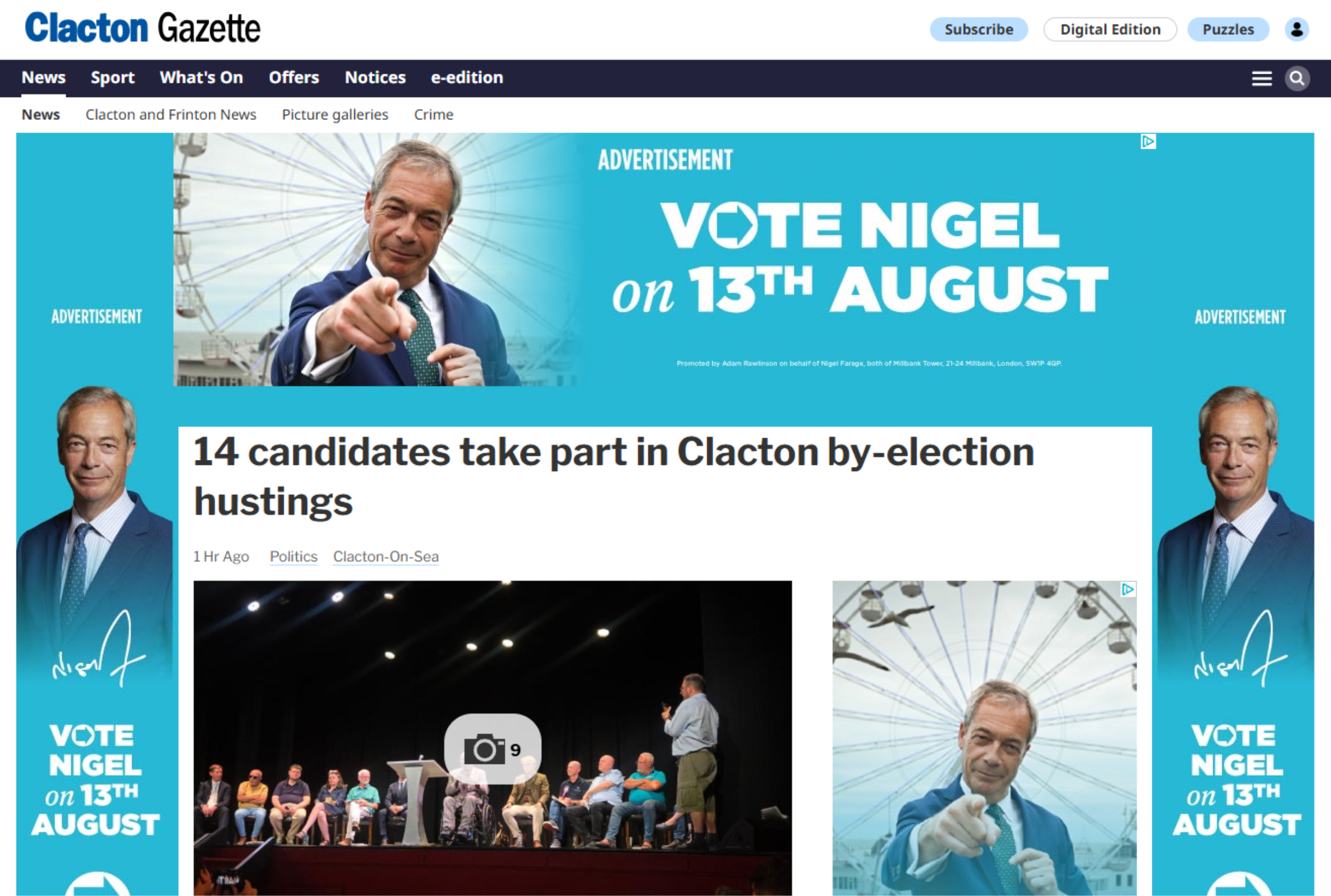
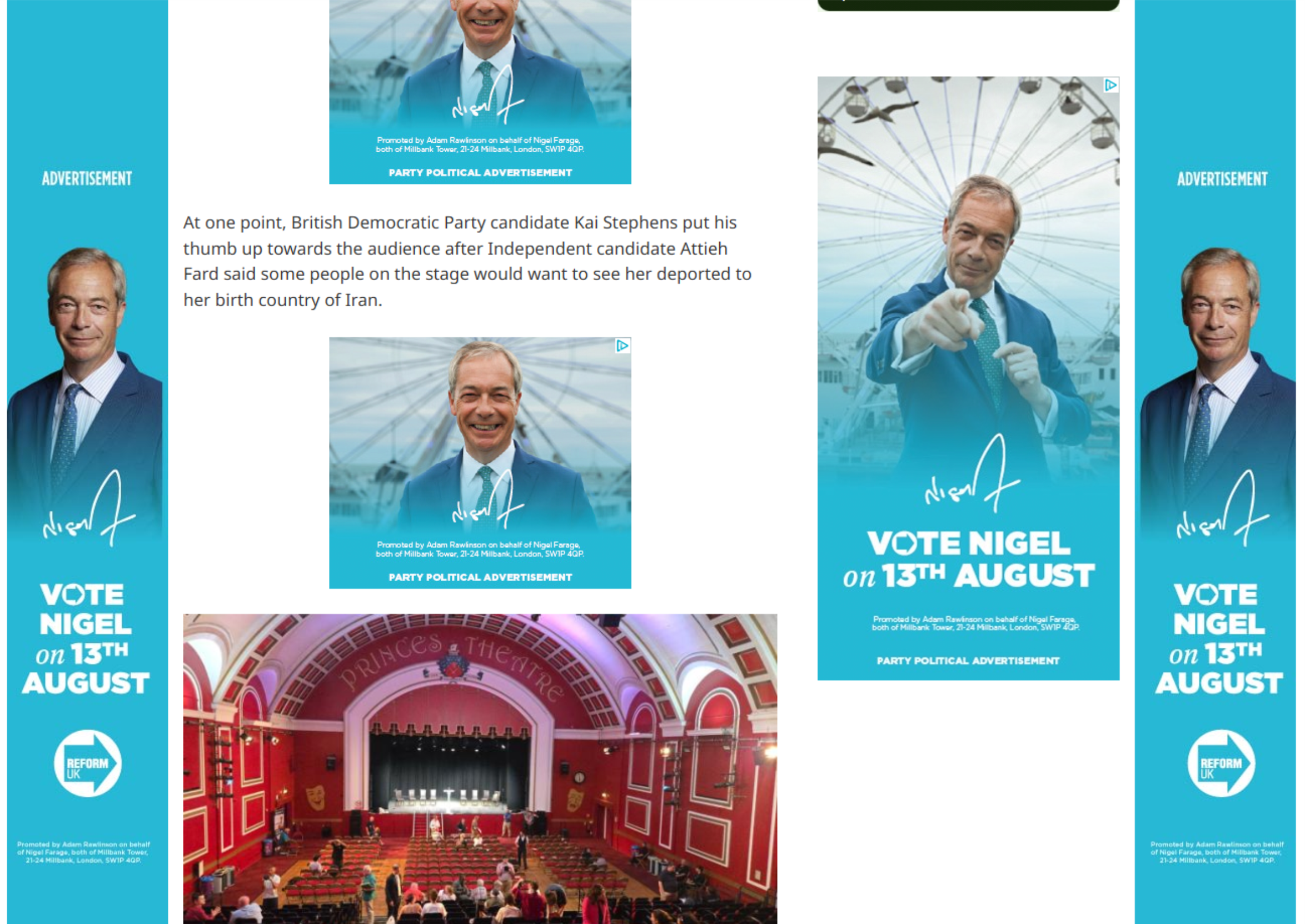
That is the issue.
I am not alleging that accepting political advertising is itself unlawful. Nor am I alleging that an advertiser purchasing a large campaign automatically proves editorial bias.
I am saying that the combined effect of weak editorial coverage of most candidates and saturation advertising for one candidate creates a presentation that, in my view, fails the standard of fairness local voters should reasonably expect during an election.
Newsquest says its local newspapers are politically neutral
The Clacton & Frinton Gazette is a Newsquest publication.
Newsquest publishes its own editorial policy.
Newsquest also says its editors have editorial independence, act in the interests of the communities they represent and aim to provide local journalism to a professional standard which readers can trust.
That makes the question entirely reasonable:
Is the presentation we have documented consistent with the standard local readers should expect from a newspaper describing itself as politically neutral?
Newsquest’s definition of political neutrality is narrow. It means its local papers are not formally affiliated with a political party or movement.
I believe local voters are entitled to expect something more meaningful during an election, particularly from one of the area’s principal news organisations.
Political neutrality should not merely mean that there is no party membership card pinned to the editor’s wall.
It should mean making a serious effort to ensure that local people can discover the choices actually available to them.
The uncomfortable truth: the rules allow much of this
It is important to be accurate about the law and the current press rules.
Newspapers are not subject to the same election-period impartiality rules as television and radio broadcasters.
IPSO does not require political impartiality
The Editors’ Code allows newspapers to take political positions and even to be partisan during elections.
IPSO’s rules focus instead on matters including accuracy and clearly distinguishing fact from comment.
Political advertising has a major exemption
Political advertisements whose principal function is to influence voters are exempt from the normal CAP Code rules applying to ordinary non-broadcast advertising.
That leaves political advertising subject to a very different regulatory framework from normal commercial marketing.
Digital political adverts may require an imprint
Electoral Commission guidance says paid digital political material intended to influence support for a candidate can require a statutory imprint identifying responsibility for the material.
Unequal coverage is not automatically illegal
I am not claiming that newspapers currently have a legal duty to give every candidate equal coverage.
My argument is that this case demonstrates why some minimum election fairness standards should now be considered.
Other candidates are saying the same thing
This is not just my experience.
During the campaign and particularly around the hustings, several other candidates have told Clacton.org that they have received little or no meaningful contact, interview opportunity or substantive coverage from local or national media.
These are people whose names will appear on exactly the same ballot paper as Nigel Farage and Count Binface.
They have paid the same candidate deposit. They have gone through the same nomination process. Some have produced detailed policies, attended public meetings and made themselves available to voters.
Yet many voters will reach polling day knowing virtually nothing about them.
No newspaper can interview 34 candidates every day.
Nobody is asking for mathematically identical column inches.
But there is an enormous distance between demanding identical coverage and asking the main local newspaper to provide voters with a basic, meaningful route to information about everyone standing.
Being on the ballot is not the same as being heard
Democracy is not simply the administrative act of printing 34 names on a piece of paper.
Meaningful democracy requires voters to have some reasonable opportunity to understand those choices.
When political parties with national organisations, wealthy supporters, press teams and large advertising budgets can dominate attention, candidates without those resources start the campaign at an enormous disadvantage.
Media attention then creates more media attention.
Pollsters ask about candidates people have heard of. Journalists report the polling. More articles are written about those candidates. Search engines display more of those articles. The cycle reinforces itself.
Meanwhile, somebody standing on a serious local platform can remain almost invisible.
That does not just disadvantage candidates.
It disadvantages voters.
What I am actually asking for
I am not asking government to decide what newspapers are allowed to think.
I am not asking newspapers to endorse every candidate.
I am not asking for identical coverage.
I am asking for a minimum democratic standard during elections.
We have made a formal complaint
On 7 August 2026 I submitted an open letter and formal complaint about the Gazette’s election coverage and the saturation political advertising displayed around its hustings report.
The complaint has been addressed for consideration by the Clacton & Frinton Gazette and Newsquest, IPSO, the Editors’ Code of Practice Committee, the Advertising Standards Authority and CAP, the Electoral Commission and relevant government departments.
The complaint includes preserved screenshot evidence showing how the article appeared to readers.
It does not allege that unequal newspaper coverage is automatically unlawful.
It asks whether the current rules are adequate for modern elections where a local newspaper website can be one of the principal sources through which voters discover candidates.
The question the Gazette needs to answer
If the answer under the current rules is yes, then I believe the rules are inadequate.
Local journalism matters enormously.
Strong local newspapers hold councils, MPs, businesses and institutions to account. Communities need them.
That is precisely why this matters.
The more important a newspaper is to its local community, the greater the damage when voters lose confidence that the election information they are receiving gives them a fair opportunity to understand their choices.
Right of reply
Clacton.org invites the Clacton & Frinton Gazette and Newsquest to respond to the issues raised in this article and in the formal complaint.
We would particularly welcome clarification about the safeguards between political advertising sales and editorial decisions, the basis on which candidate coverage is selected, and whether equivalent advertising opportunities were available to all candidates on equivalent commercial terms.
Any substantive response will be published prominently and fairly.
Sources and evidence
-
Clacton.org – How Does an Independent Candidate Get Heard?
How does an independent candidate get heard?
- Open Letter and Formal Complaint – Clacton Gazette By-Election Coverage https://clacton.org/wp-content/uploads/2026/08/Open_Letter_and_Formal_Complaint_Clacton_Gazette.pdf
- Clacton & Frinton Gazette – 14 candidates debate in Clacton by-election hustings https://www.clactonandfrintongazette.co.uk/news/26444537.14-candidates-debate-clacton-by-election-hustings/
- Screenshot evidence – Gazette / Nigel Farage advertising 1 https://clacton.org/wp-content/uploads/2026/08/Gazette-NF-Unfair-1.png
- Screenshot evidence – Gazette / Nigel Farage advertising 2 https://clacton.org/wp-content/uploads/2026/08/Gazette-NF-Unfair-2.png
- Newsquest – Editorial Policy https://www.newsquest.co.uk/about-us/
- IPSO – Editors’ Code of Practice https://www.ipso.co.uk/editors-code-of-practice/
- IPSO – Editors’ Code FAQ on political bias and election coverage https://www.ipso.co.uk/editors-code-of-practice/faqs-editors-code/
- Advertising Standards Authority / CAP – Political Advertising https://www.asa.org.uk/advice-online/political-advertising.html
- Electoral Commission – Digital Imprints https://www.electoralcommission.org.uk/political-registration-and-regulation/imprints/imprints-digital-material