
The Gazette Gave Candidates 250 Words. Nigel Farage Advertising Took Over The Page.
I am standing as an Independent candidate in the Clacton by-election. The Clacton & Frinton Gazette has never contacted me about my candidacy, and I have received no reply to any of the emails I have sent them. I had to chase simply to get my 250 words included. When they finally appeared, my section was surrounded by Vote Nigel advertising.
Every political advert I saw on the candidate article promoted Nigel Farage .
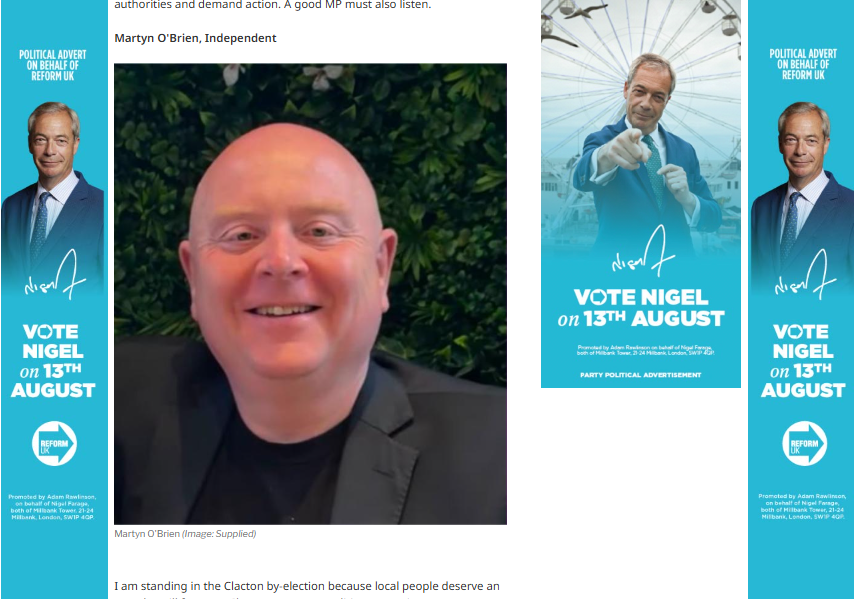
I am standing in this election. The Gazette has never contacted me.
I am one of the 34 candidates whose names will appear on the Clacton ballot paper on Thursday 13 August. Despite that, the Clacton & Frinton Gazette has never contacted me about my candidacy.
As at the publication of this report, I have also received no reply to any of the emails I have sent them.
I was not approached for an interview.
I was not asked why I am standing.
I was not asked about my policies.
I was not contacted and invited to provide my 250-word statement.
I had to chase them myself to make sure I was included.
Eventually, my photograph and my statement appeared.
Then people started sending me the Gazette link.
I opened it and found my contribution sitting in a page filled with advertising for one of the people I am standing against, Nigel Farage .
There were Vote Nigel banners across the top.
More down both sides.
More inside the article.
More beside other candidates.
In some cases, the adverts repeatedly appeared as readers tried to work through another candidate’s short contribution.
I counted 16 visible political advertising placements while reviewing the article.
Every political advert I saw promoted the same candidate: Nigel Farage .
The issue is the cumulative effect of one candidate’s campaign appearing again and again around an article supposedly giving voters an opportunity to read what his opponents have to say.
Want to read what the candidates actually said without the Vote Nigel advertising? Search a candidate name, use the filters and follow the link to their full Clacton.org profile.
We raised the problem before. It has not gone away.
This is not the first time I have raised concerns about how this election is being presented to local voters.
Clacton.org has already documented the difficulty independent and lesser-known candidates face getting meaningful media coverage, and concerns about the Gazette’s local election reporting.
Local Press Fail On Impartiality
Our earlier report examined the Gazette’s hustings coverage, the limited information given about many candidates and the repeated Nigel Farage advertising surrounding that journalism.
Read The Original ReportHow Does An Independent Candidate Get Heard?
Our media audit examined just how difficult it can be for an Independent candidate to receive meaningful coverage when attention concentrates on famous politicians, major parties and novelty candidates.
Read The Media AuditThis is what voters were actually seeing.
I do not expect people to simply take my word for it.
I captured the page.
The screenshots show candidate after candidate being presented inside the same repeated Vote Nigel advertising environment.
A note about the number 16: this is the number of visible advertising placements I counted while reviewing the article. It does not necessarily mean 16 completely separate advertising purchases were made. The same campaign can be served repeatedly into different advertising positions.
What matters here is what the reader actually saw on the finished page.
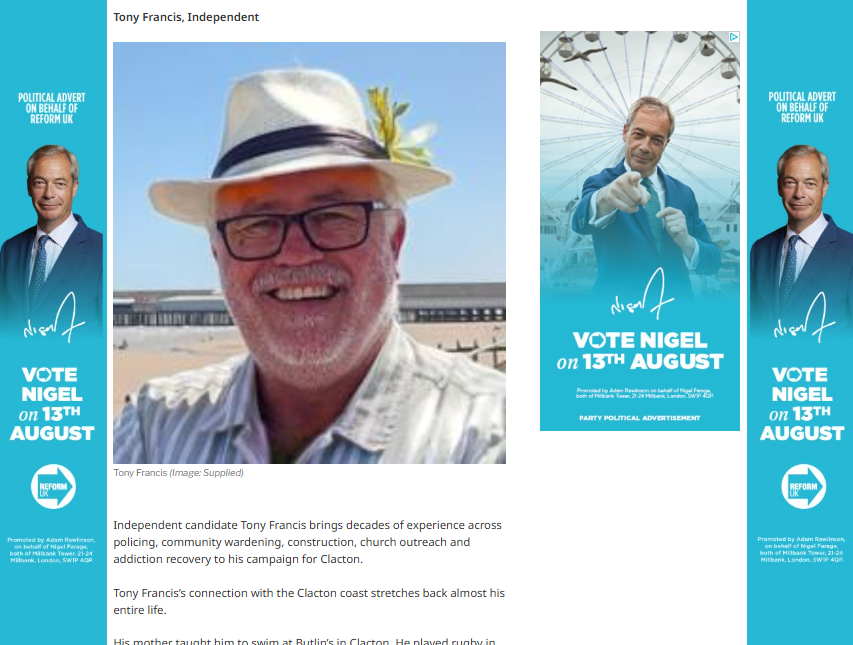
Tony Francis
Tony Francis is standing as an Independent candidate. His photograph and candidate statement appear alongside repeated Vote Nigel advertising.
Open Full Screenshot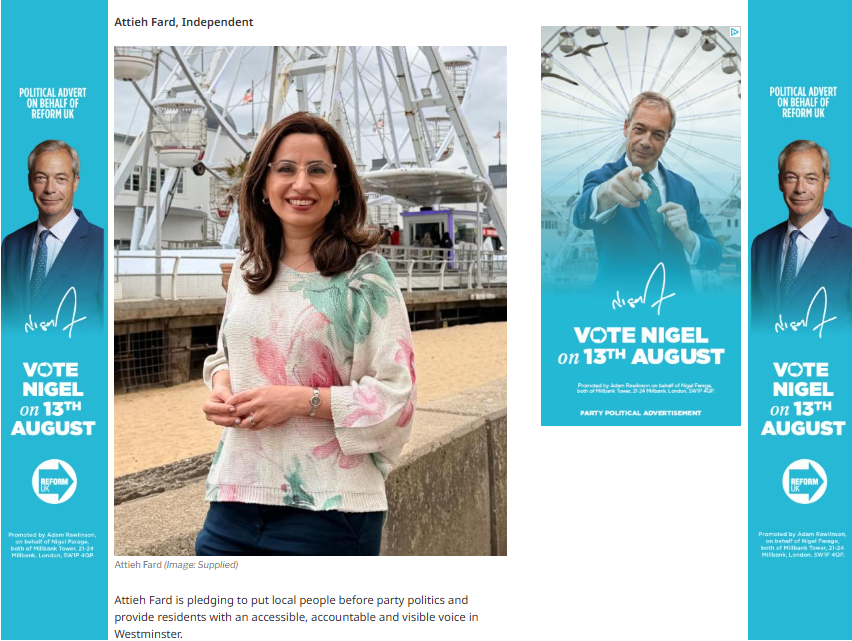
Attieh Fard
Independent candidate Attieh Fard is presented with prominent Vote Nigel campaign advertising around her contribution.
Open Full Screenshot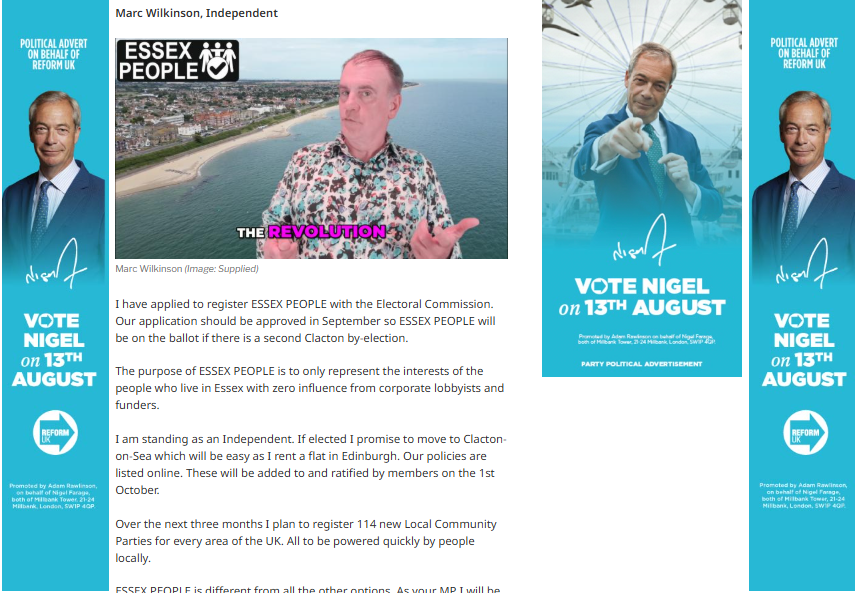
Marc Wilkinson
Marc Wilkinson appears on a screen where multiple Vote Nigel adverts surround his photograph and statement.
Open Full Screenshot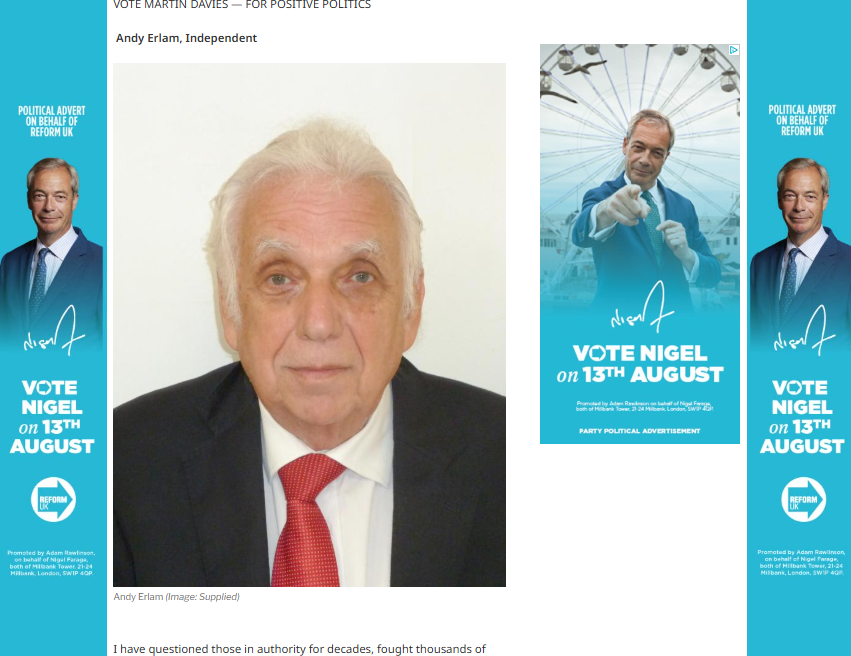
Andy Erlam
Independent candidate Andy Erlam is another example of a rival candidate appearing inside the repeated Vote Nigel advertising environment.
Open Full Screenshot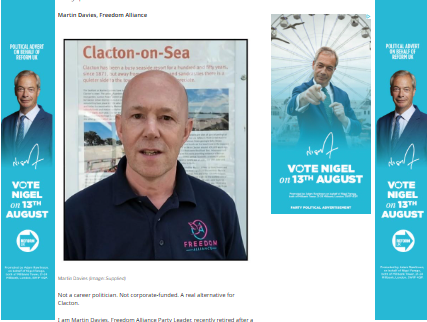
Martin Davies
Freedom Alliance candidate Martin Davies is presented within the same repeated campaign advertising.
Open Full Screenshot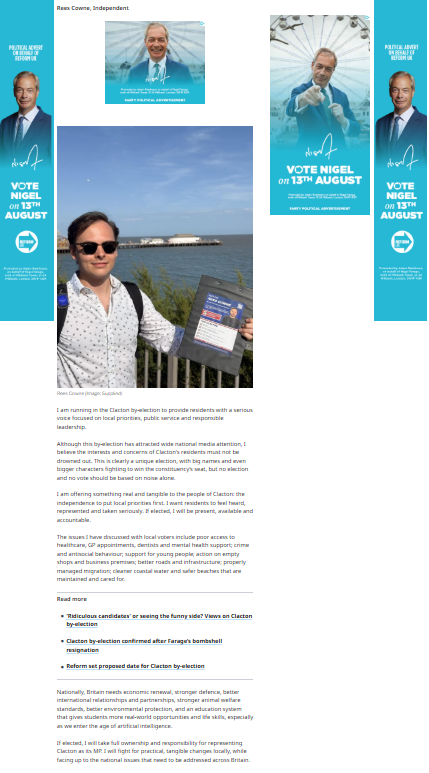
Rees Cowne
Independent candidate Rees Cowne is shown as the advertising continues to repeat throughout the page.
Open Full Screenshot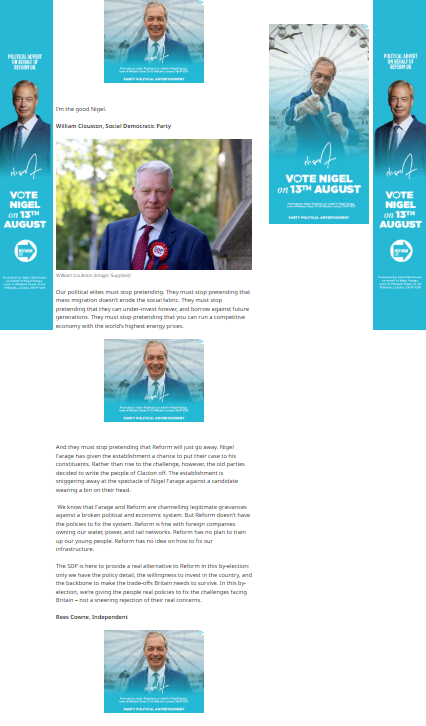
William Stuart James Clouston
Social Democratic Party candidate William Stuart James Clouston is shown with Vote Nigel advertising repeatedly appearing around his contribution.
Open Full Screenshot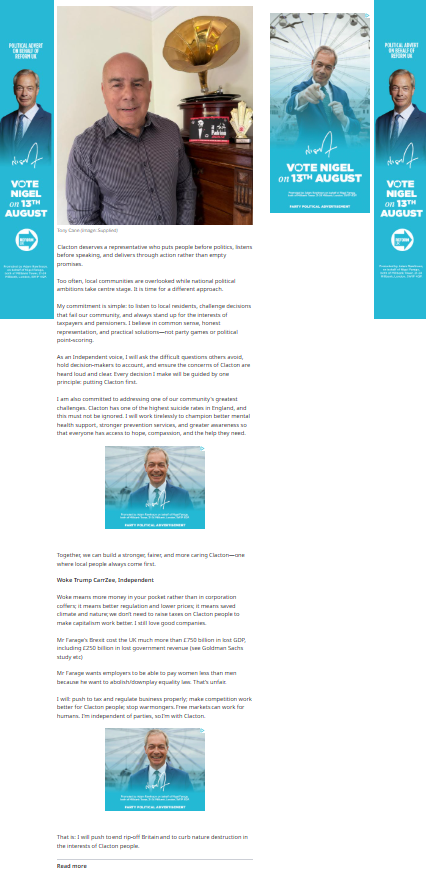
Tony Cane
Independent candidate Tony Cane is another candidate whose statement appears within the repeated Vote Nigel campaign.
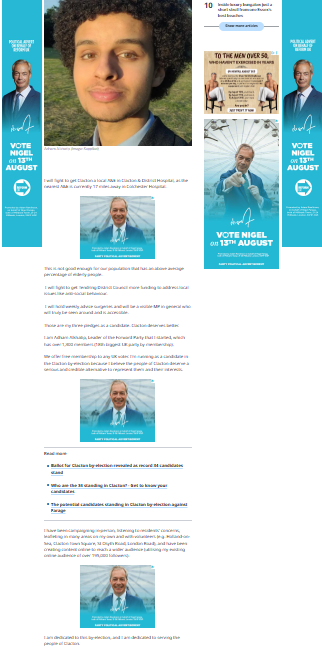
Open Full ScreenshotAdham Alkhatip : around 250 words, six Nigel Farage images
On a mobile phone in particular, trying to read Adham Alkhatip ‘s short candidate statement became an exercise in repeatedly scrolling through advertising for Nigel Farage .
Adham Alkhatip, The Forward Party
Adham Alkhatip was given approximately the same 250 words as the other candidates to explain himself and his policies to Clacton voters.
Across that short contribution, I counted six advertising images promoting Nigel Farage .
This is particularly striking on a mobile phone.
On a desktop screen, some advertising sits down the sides. On a narrow mobile screen, the reader experiences the article vertically.
You read some of Adham Alkhatip ‘s words.
Then Nigel Farage .
More of Adham Alkhatip ‘s words.
Then Nigel Farage again.
The campaign material becomes part of the actual reading experience.
Reading approximately 250 words from Adham Alkhatip without repeatedly encountering Nigel Farage campaign advertising becomes unnecessarily difficult, especially on a mobile screen.
Six advertising images promoting Nigel Farage . On mobile, the advertising does not simply sit beside the journalism. It becomes part of the journey through it.
These are candidates, not background decoration for somebody else’s campaign.
The screenshots show candidates from different parties, backgrounds and political positions.
Whatever anyone thinks of their politics, they are standing in the same parliamentary election and voters should have a reasonable opportunity to read what they have to say.
This advertising campaign was deliberate. The unanswered question is how deliberately this page was targeted.
Political advertising does not appear by magic.
Someone planned the campaign.
Someone authorised it.
Someone paid for it.
Decisions were made about when, where and to whom Vote Nigel advertising should be shown.
In that sense, the campaign promoting Nigel Farage was plainly planned, organised and deliberate.
What these screenshots alone cannot tell us is exactly how this particular Gazette article ended up so heavily saturated.
Of course newspapers sell advertising.
The question is why a system operated by, sold through or supplying advertising to a major local newspaper allows one election candidate to occupy repeated advertising positions around an article specifically inviting voters to read what his opponents have to say.
Was this article specifically selected?
Was Clacton geographically targeted?
Was election or political content targeted?
Was the advertising purchased directly through Newsquest?
Was an advertising agency involved?
Was it delivered through automated programmatic advertising?
Was there any frequency cap preventing the same political campaign from occupying multiple positions on the same article?
Newsquest has access to this information. Its readers do not.
Repeated Vote Nigel advertising surrounding and appearing throughout editorial sections presenting rival candidates.
The cumulative presentation gives Nigel Farage an extraordinary visual advantage and is not a fair way to present an election comparison.
Who purchased it, how it was targeted, how frequently it was served and whether this candidate article or election-related content was specifically targeted.
I am not claiming that these screenshots prove a Gazette editor manually positioned every advert next to every opposing candidate.
What I am saying is that the pattern is sufficiently extensive, and the effect on the presentation of rival candidates sufficiently obvious, that Newsquest should explain exactly how it happened.
Equal word count does not mean equal presentation.
On paper it sounds fair.
Give every candidate approximately 250 words.
Publish their photograph.
Let voters read what they have to say.
But presentation matters.
If one candidate’s words are repeatedly surrounded by advertising for another candidate, the reader is not receiving a neutral visual presentation of those statements.
VOTE NIGEL.
The fact that a website may technically separate advertising systems from editorial systems does not alter what appears on a voter’s screen.
The reader experiences the finished page.
They see Tony Francis .
Then Nigel Farage .
They see Attieh Fard .
Then Nigel Farage .
They try to read Adham Alkhatip .
Across roughly 250 words they encounter six advertising images promoting Nigel Farage .
That cumulative effect is the problem.
I would say the same thing if those adverts said Vote Martyn.
This is bigger than Nigel Farage .
If six Vote Martyn adverts appeared while somebody was trying to read 250 words from Nigel Farage , Adham Alkhatip , Tony Francis , Attieh Fard or any other candidate, I would still think the newspaper had a serious problem.
Newspapers need advertising revenue.
Candidates and political parties are entitled to advertise within the rules.
But editorial content specifically designed to help voters understand an election should not become the wrapper for saturation advertising by one of the candidates being compared.
A simple safeguard: during an election, candidate-specific political advertising should not surround, interrupt or dominate editorial content specifically presenting that candidate’s electoral opponents.
Questions for the Clacton & Frinton Gazette and Newsquest
This time, I want an explanation.
I have already raised concerns about local election coverage.
I have already emailed.
I have already published a detailed report.
I have already made a formal complaint.
I have received no reply to my emails from the Gazette.
Now I have further screenshot evidence showing candidate statements surrounded and, in some cases, repeatedly broken up by advertising for one of their opponents.
Maybe Newsquest has a technical explanation.
If it does, publish it.
Tell us who bought the advertising.
Tell us how it was targeted.
Tell us whether this election article was specifically targeted.
Tell us how approximately 250 words from Adham Alkhatip ended up alongside six advertising images promoting Nigel Farage .
And tell Clacton voters whether this is really the standard of election journalism and political advertising they should expect from one of their principal local news sources.
Clacton.org invites the Gazette and Newsquest to respond.
The Clacton & Frinton Gazette and Newsquest are invited to provide a substantive response explaining how the political advertising shown in these screenshots was purchased, targeted and served around the candidate article.
We would particularly welcome confirmation of whether this specific article or election-related content was deliberately targeted, the number of advertising impressions served, any frequency controls applied, and whether equivalent advertising opportunities were available to other candidates.
Any substantive response received will be added prominently and fairly to this report.